30 Journal Prompts to Help You Reflect on Your Day
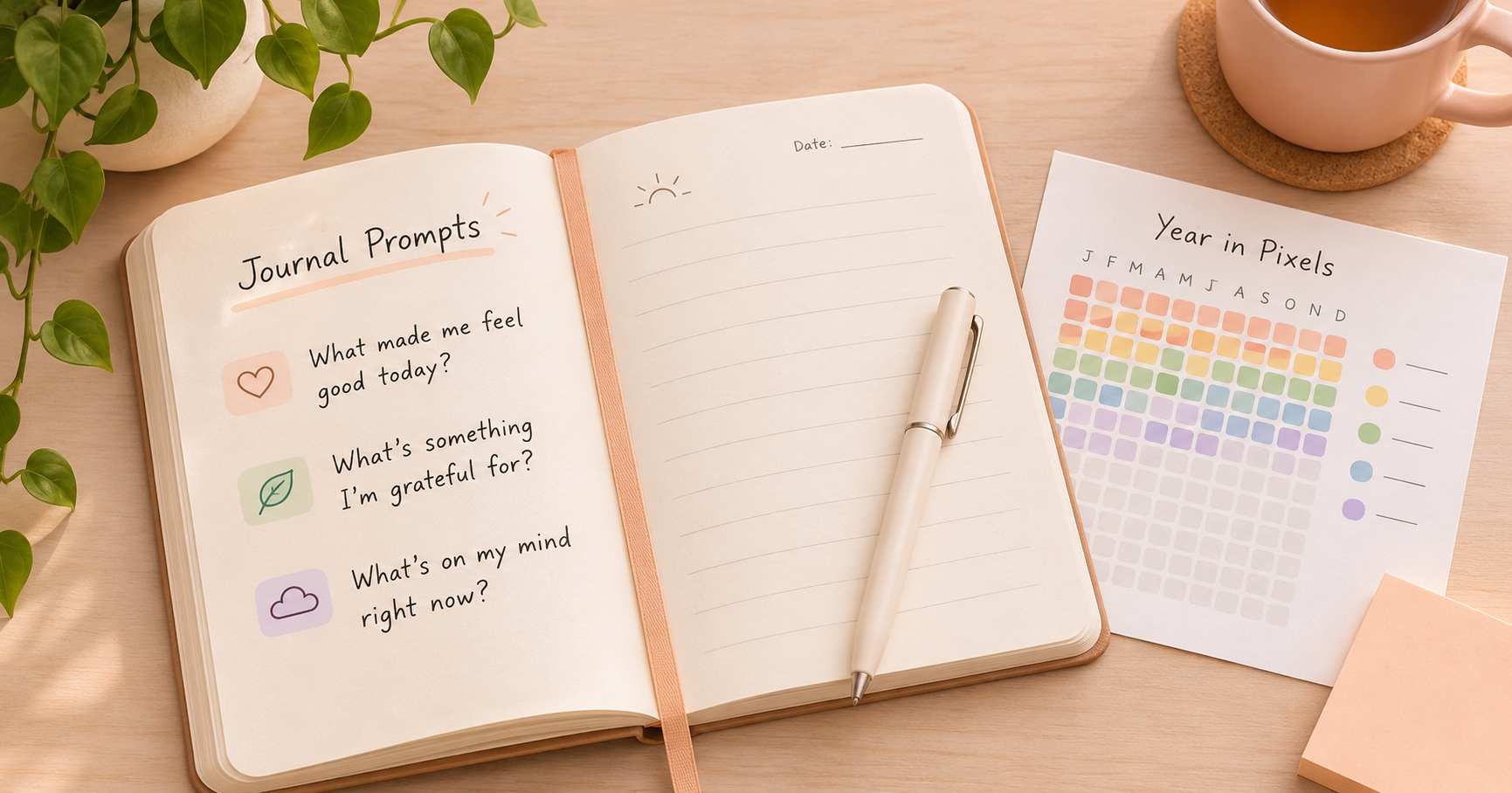
Starting a journal entry can feel surprisingly difficult. You may want to write, but not know where to begin—or feel as though nothing important happened.
A good journal prompt removes that pressure. Instead of trying to summarize your entire day, you can answer one small, specific question. That may lead to a few words, a short list, or a longer reflection.
These 30 prompts are drawn from the writing tools built into Yian. They cover everyday memories, gratitude, emotions, challenges, growth, and recurring patterns. Choose whichever question feels useful today. You do not need to answer them in order or complete the entire list.
Journal prompts for remembering your day
Not every journal entry needs to uncover a profound insight. Recording ordinary details can help you remember what your life actually felt like—not just its biggest events.
Yian includes structured templates such as Quick Log, Activity Log, Daily Snapshot, Timeline Log, and Hourly Log. The following questions turn some of those recording fields into simple prompts.
1. What were today’s highlights?
Write down anything you would like to remember. A highlight can be an accomplishment, a conversation, a meal, a funny moment, or something unexpectedly peaceful.
2. What happened in the morning?
Think about how you woke up, where you went, what you did first, and how the beginning of the day felt.
3. What happened in the afternoon?
Record the activities, people, decisions, or changes in energy that shaped the middle of your day.
4. What happened in the evening?
Consider how you spent your time once the main responsibilities of the day began to wind down.
5. What happened at night?
Note your final activities, thoughts, routines, or feelings before going to sleep.
6. What happened at work or school?
You might record what you worked on, something you learned, a problem you solved, or an interaction that stayed with you.
7. What did I do for my health?
This could include exercise, rest, medication, time outside, preparing food, attending an appointment, or simply listening to your body.
8. What social moments stood out?
Think about conversations, messages, shared activities, or moments when you felt especially connected—or disconnected.
9. How did I sleep?
Record the amount or quality of your sleep and how it appeared to affect your mood, focus, or energy.
10. What meals did I have?
Meals can help anchor a memory. You could note what you ate, where you ate, who was there, and whether you enjoyed it.
11. Which places did I visit, and who did I spend time with?
This creates a simple record of the settings and people that made up your day.
12. What media did I watch, read, play, or listen to?
Record a book, article, show, game, podcast, song, or video you enjoyed—or something that made you think.
Journal prompts for gratitude and support
Gratitude journaling does not require pretending everything is positive. It is simply a way to notice moments of comfort, help, meaning, or enjoyment alongside everything else that happened.
13. What am I grateful for today?
Try to be specific. Instead of writing “my friends,” you might write about a particular message or conversation that helped you.
14. What small moment felt good?
Consider a moment that could easily have been forgotten: sunlight through a window, finishing a task, making someone laugh, or enjoying a quiet cup of coffee.
15. Who or what helped me?
Support can come from a person, a routine, an object, a place, or a decision you made for yourself.
Journal prompts for understanding your emotions
You do not need a perfect label for every feeling. These prompts are intended to help you pause, notice what is present, and become curious about it.
16. What emotions showed up today?
List as many as you need. A day can contain calm, frustration, excitement, boredom, sadness, and relief without any of those feelings canceling out the others.
17. What may have caused them?
Think about events, thoughts, physical sensations, expectations, or interactions that may have contributed to how you felt.
18. What do they tell me I need?
An emotion might point toward rest, reassurance, space, connection, movement, clarity, or a boundary.
Journal prompts for difficult days
Writing about a challenge can help separate the situation itself from the thoughts and feelings surrounding it. You do not have to solve everything in one entry.
19. What felt difficult today?
Name the part that felt hard without minimizing it or comparing it with someone else’s experience.
20. What made it hard?
Consider whether the difficulty came from uncertainty, limited time, fatigue, conflict, pressure, fear, or several factors at once.
21. What helped, even a little?
Look for anything that reduced the difficulty by a small amount. It might be a break, a conversation, a change of environment, or simply getting through the moment.
22. What is still in my control?
Focus on one realistic choice you can make. That might mean asking for help, changing your approach, setting a boundary, or allowing yourself to rest.
Journal prompts for growth
Personal growth is often subtle. It can look like responding differently, recovering more quickly, understanding yourself better, or taking one small step.
23. What did I improve at today?
Improvement does not need to mean mastery. Notice any skill, habit, decision, or response that felt slightly better than before.
24. What did today teach me?
The lesson may be practical, emotional, or personal. It could also be something you learned about another person or your surroundings.
25. What do I want to keep doing?
Identify an action, attitude, routine, or choice that you would like to carry into tomorrow.
26. One small next step:
Choose something specific enough to begin. “Open the document” is often more useful than “finish the project.”
Journal prompts for recognizing patterns and triggers
Revisiting similar prompts over time can reveal patterns that are difficult to notice within a single day. You may begin to see which situations affect your mood, what supports your energy, and how you typically respond.
27. What kept coming up today?
This could be a repeated thought, feeling, concern, distraction, physical sensation, or type of interaction.
28. What seemed to trigger it?
Think about what happened immediately before the pattern appeared. Try to observe it without judging yourself.
29. How did I respond?
Record what you thought, felt, said, or did. Your response does not need to have been ideal for it to be worth understanding.
30. What would I repeat or change next time?
Identify something that worked or one adjustment you would like to try if a similar situation happens again.
How to choose a journal prompt
You do not need to choose the most serious question. Start with the prompt that feels easiest to answer.
If the day is becoming blurry, use one of the recording prompts. If you feel unsettled, try an emotion or challenge prompt. When you want to look ahead, choose a growth question. If you have been noticing the same experience repeatedly, use one of the pattern prompts.
It can also help to answer the same prompt for several days. Repetition is not a failure to find something new—it is often how patterns become visible.
Short journal entries still count
A response does not need to be eloquent or complete. A useful entry might be:
I felt restless during the afternoon. I think I needed a proper break instead of switching between tasks. Tomorrow, I’ll go outside for ten minutes after lunch.
That is enough. It records an emotion, a possible cause, a need, and a small next step.
On another day, your entry may only be a sentence or a list of highlights. The value comes from creating a record you can return to, not from reaching a certain word count.
Using journal prompts in Yian
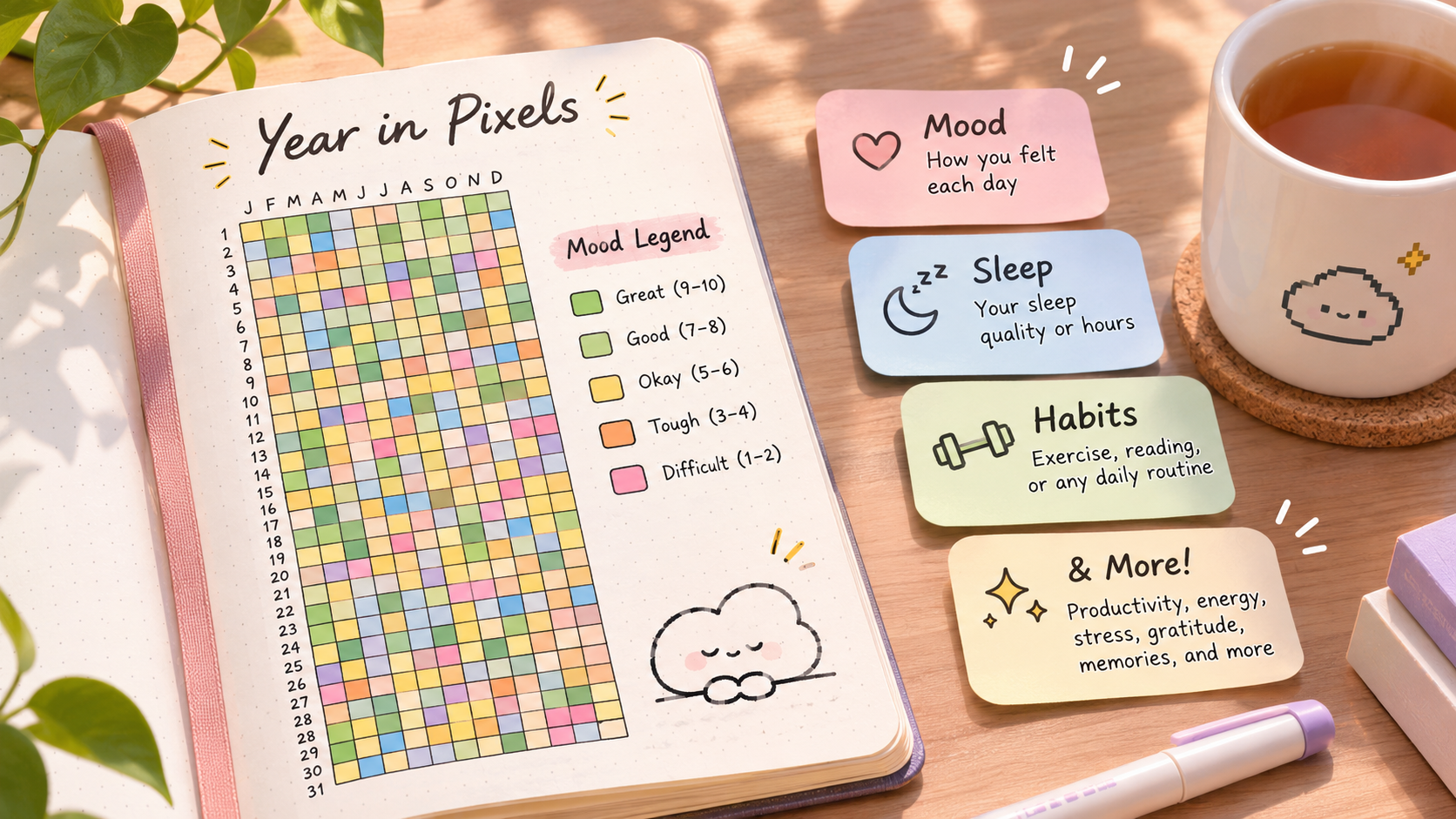
Yian combines daily notes with mood tracking and a visual Year in Pixels calendar.
Its built-in Record and Reflect templates are available without Premium. Record templates help capture details such as activities, sleep, meals, people, places, and different parts of the day. Reflect templates cover gratitude, emotions, challenges, growth, patterns, and triggers.
Yian Premium also lets you create, edit, reorder, and reuse your own custom writing prompts. This can be useful if you regularly journal about a particular habit, project, relationship, health goal, or personal practice.
If you are curious about where the app came from, you can also read the story behind Yian.
A simple way to begin
Choose one question from this list and answer it in the smallest useful amount of detail. Return tomorrow and choose another—or answer the same one again.
Over time, these entries can become more than isolated reflections. Together, they create a record of what you experienced, what affected you, and how you changed.
Comments
Join the discussionNo comments yet. Be the first to comment.